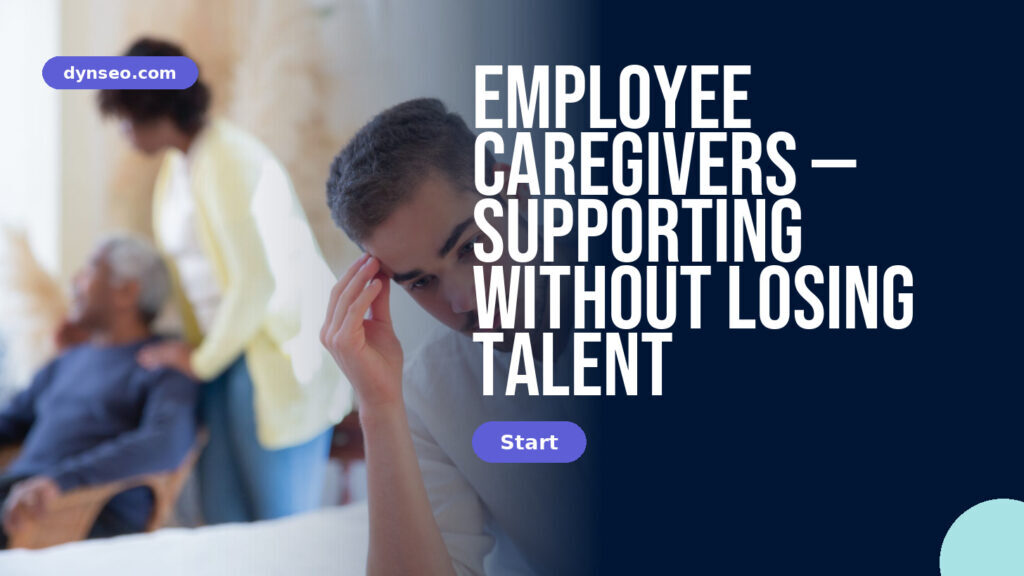
Employee caregivers: how to identify and support them without losing your talents
1 in 5 employees is a caregiver for a loved one. Burnout, absenteeism, loss of concentration, turnover — the consequences on performance and engagement are real. This practical guide provides managers and HR with concrete keys to identify and support these invisible collaborators.
In this article
The associated training
Our printable notebooks



She always arrives among the first in the morning. Her rigor is exemplary, her commitment unwavering for 7 years. For a few months, she has been responding to messages at 10 PM, she seems absent in meetings, she has taken several emergency days off. Her manager hasn’t said anything — he thinks she is going through a difficult time. In reality, she is solely caring for her father who has Alzheimer's disease since her mother passed away, and she doesn’t talk about it because she fears being perceived as less reliable. She is an employee caregiver. And she is two months away from burnout. This scenario plays out every day in thousands of French companies — often without anyone seeing it coming, due to a lack of tools to identify and respond to it. This practical guide provides you with those tools.
1. Who are employee caregivers? A portrait in numbers
1.1 A massive and structural phenomenon
The term employee caregiver refers to any collaborator who provides regular support to a dependent, disabled, seriously ill, or highly fragile loved one outside of their working hours (and sometimes during). This loved one can be an elderly parent, a sick spouse, a child with a disability, a brother or sister suffering from a psychiatric disorder, or a close friend considered family.
In France, according to consolidated data from DREES, the April Foundation, and the National Solidarity Fund for Autonomy, the total number of caregivers is estimated at 11 million — of which about 4.3 million are simultaneously engaged in professional activities. This represents an average of one in five employees in French companies. This ratio rises to one in four among those over 50 — an age group that often represents the most experienced and hardest-to-replace profiles in organizations.
caregivers in France — of which 4.3 million are professionally active, or about 1 in 5 employees in French companies
estimated productivity loss among unsupported employee caregivers (IFOP / Novartis Foundation, 2022)
spent on average per day on caregiving, in addition to working hours — equivalent to the burden of a second unpaid part-time job
higher risk of burnout among employee caregivers vs. non-caregivers (INRS, RPS survey, 2021)
1.2 Caregiver profiles in the workplace
The caregiver is not a unique profile. In the workplace, we mainly encounter four caregiving situations that generate different adaptation needs.
👴 Caregiver of a dependent elderly parent
- Most frequent situation, mainly affects those aged 40-60
- Variable intensity: from a few hours/week to daily presence
- Unpredictable crisis peaks (fall, hospitalization, end of life)
- Can last for years — gradual exhaustion
- Frequent feelings of guilt regarding work
🧒 Caregiver of a child with a disability
- Affects employees of all ages and hierarchical levels
- Rigid scheduling constraints (medical appointments, therapies)
- Very intense and lasting emotional dimension
- Risk of social and professional isolation
- May require permanent schedule adjustments
💔 Caregiver of a sick spouse
- Maximum impact on the organization of private and professional life
- Loss of previous family balance, mourning of the couple's project
- Often silent suffering, experienced as very intimate
- High risk of confusion between caregiver and caregiver
- Social isolation amplified by shame or modesty
🧠 Caregiver of a loved one with a psychiatric disorder
- Least known and least supported situation
- Unpredictability of crises — impossible to anticipate
- High emotional burden, risk of rapid burnout
- Strong stigma — the employee generally does not talk about it
- Need for understanding, not just for provisions
2. Identifying an employee caregiver without invading their privacy
2.1 The challenge of the invisible employee caregiver
The first difficulty in supporting employee caregivers is their invisibility. Unlike other situations (sick leave, pregnancy, accident), caregiving is neither visible nor systematically declared. For many employee caregivers, silence is a protective strategy: they fear being perceived as less available, less reliable, less promotable. They are often right to have this fear — unconscious biases about "employees with personal problems" are real in many organizations.
The result: managers and HR only see the symptoms (absenteeism, decreased performance, irritability, recurring delays) without identifying the cause. They often react with reprimands or performance reviews — worsening the situation of an employee who precisely needed to be understood and supported.
💡 Golden rule: Identifying an employee caregiver is not an intrusion into their private life — it is observing professional behaviors and creating the conditions for an open conversation. The difference between inappropriate curiosity and benevolent management lies in the posture: "I observe that you seem to be going through a difficult time — I am available if you want to talk" is not a question about private life.
2.2 Professional signals to observe
| Area | Early signals (stage 1) | Alert signals (stage 2) | Crisis signals (stage 3) |
|---|---|---|---|
| Presence | Repeated late arrivals or early departures, frequent phone checking | Short and frequent unplanned absences, emergency days off | Repeated sick leaves, notable disorganization of their schedule |
| Concentration | Seems preoccupied, rereading documents, repeated questions | Unusual mistakes, missed meetings or tasks, difficulty prioritizing | Inability to finish projects they usually managed without effort |
| Energy | Visible fatigue at the end of the day, increased consumption of coffee or stimulants | Permanent exhaustion, phrases like "I can't take it anymore" or "I'm at my limit" | Crying, intense irritability, total withdrawal from social interactions |
| Availability | Refuses certain tasks with unusual time constraints | Systematically declines business trips and events outside of working hours | Impossible to reach during certain times, meetings regularly interrupted |
3. Having the conversation: how to approach the subject without awkwardness
3.1 The right posture to open the dialogue
The biggest obstacle to supporting employee caregivers is the manager's fear of touching on something they don't know how to handle afterward. This fear is understandable — but it should not lead to silence. A manager who ignores the signals does not avoid the problem: they allow it to worsen until it becomes unavoidable to address. There is a simple rule: better an awkward but kind conversation than no conversation at all.
💬 Example of an opening conversation manager / employee caregiver
3.2 What not to do
Directly questioning about private life
“Is your father sick? What exactly is the illness?” is not a managerial conversation — it is an intrusion. The manager does not need to know the details of the personal situation. What matters to them: how to adapt the work so that the employee can continue to contribute.
Open to dialogue without forcing
“I sense that you are going through a difficult time — I am available if you want to talk” opens a door without forcing entry. If the employee does not want to talk, that is their right. The essential thing is that they know their manager has noticed and is available.
Minimizing or normalizing
“It’s hard for everyone” or “It will be fine, you are strong” are responses that close the conversation rather than open it. They deny the reality of the caregiving burden and discourage the employee from coming back to their manager next time.
Recognize without substituting the therapist
“It’s a really difficult situation and I understand that it requires a lot of energy” acknowledges the reality without dramatizing or minimizing. The manager is not a therapist — their role is to recognize, adapt the work, and direct to the right resources.
Leaving the situation without follow-up
An opening conversation without follow-up generates a feeling of abandonment worse than the initial silence. The employee has taken the risk of showing vulnerability — if nothing changes and no one follows up with them, they will shut down completely.
Plan for regular follow-up
“I’ll check back with you in 15 days to see if the adjustments we’ve made are working” materializes the commitment. This regular follow-up — even if brief — keeps the communication channel open and allows for adjustments as needed.
Employee caregivers: supporting without losing your talents
The DYNSEO certified training that provides managers, HR, and executives with concrete tools to identify employee caregivers, adapt their management, implement appropriate provisions, and avoid burnout and turnover. 100% online, at your own pace, deployable in multi-licenses.
Access the training →4. Concrete measures that the company can implement
4.1 Organizational adaptation measures
Flexible hours
Adjustment of mandatory presence times, shifting of start times or anticipating end of day, possibility to recover hours taken in emergencies. Does not require heavy HR provisions — can often be decided at the level of the direct manager in many organizations.
Extended telework
Access to telework — even for positions that did not usually use it — can transform the life of an employee caregiver by eliminating travel time, allowing for quick interventions at home, and reducing fatigue related to juggling roles.
Right to disconnect and protected breaks
Formalizing that the employee caregiver is not expected to be available outside of their contractual hours — even during intense periods. This explicit protection reduces guilt and the spiral of exhaustion related to constant dual availability.
Emergency caregiver leave
Beyond the legal caregiver leave, some companies have implemented additional days off to deal with unforeseen emergencies — without having to take personal leave or RTT at the last minute. This simple provision has a strong impact on the perceived sense of support.
4.2 Psychological and social support measures
Organizational adaptation alone is not enough — an employee caregiver also needs support for the emotional and social burden their role represents. Several provisions allow the company to play this supportive role without encroaching on private life.
The Employee Assistance Program (EAP) is one of the most effective tools: it offers employees confidential access to professionals (psychologists, social workers, lawyers) via a phone number or online platform. For an employee caregiver, accessing legal help regarding caregiver leave or psychological support regarding guilt is invaluable — and the fact that it is confidential and outside the company is often the condition for them to seek help.
The caregiver support groups — organized internally or in partnership with specialized associations — allow employee caregivers to meet with peers, share their experiences, and break out of isolation. These groups can be easily organized in person or via videoconference, and often generate a strong community dynamic around the topic. For managers who fear that the topic is taboo in their organization, the DYNSEO training Mental health at work: freeing up speech and knowing how to direct provides the tools to create the conditions for these conversations.
5. The legal framework for employee caregivers in the workplace
⚖️ Main legal provisions for employee caregivers
- Caregiver leave (art. L3142-16 and following of the Labor Code): right to unpaid leave of 3 months renewable (maximum 1 year over the entire career) to care for a loved one in a situation of severe loss of autonomy or disability
- Daily allowance for caregiver (AJPA): since 2020, partial financial compensation paid by the CAF during caregiver leave — €58.59/day for a couple, €69.65/day for a single person (2024)
- Donation of rest days (Mathys law, 2014): an employee can anonymously donate RTT or leave days to a colleague caring for a seriously ill child — provision extended to caregivers of adults by some companies through collective agreements
- Art. L4121-1 Labor Code: employer's obligation of safety — the burden related to caregiving must be taken into account in the evaluation of RPS in the DUERP
- and AGEFIPH: if the cared-for relative is recognized as a disabled worker, AGEFIPH aids can be mobilized to facilitate the adaptation of the employee caregiver's position
- QVCT agreement: companies can integrate specific commitments regarding employee caregivers in their QVCT agreements (additional days off, EAP, extended telework policy)
The DYNSEO training Employee caregivers: supporting without losing your talents addresses all of these legal provisions in their practical dimension — how to explain them to managers, how to propose them without imposing, and how to articulate them with the overall HR policy of the company.
6. The ROI of supporting employee caregivers
6.1 The cost of invisibility
Companies that have not implemented a support policy for employee caregivers bear significant costs that they generally do not identify as such. Presenteeism (being physically present but cognitively absent or emotionally exhausted) represents, according to INRS, a productivity loss of 20 to 30% among struggling employees — and this loss is invisible in absenteeism statistics because the employee is counted as present. Absenteeism among employee caregivers is on average 30% higher than that of non-caregivers. And turnover, when the employee feels that their company cannot adapt to their situation, costs between 6 and 18 months of loaded salary depending on the level of the position.
For a company of 500 employees with 100 potential caregivers (20%), of which 20% are in significant difficulty and 10% annual turnover in this profile, the unoptimized annual cost can exceed €500,000 — not counting indirect costs related to decreased quality, legal RPS risks, and impact on employer branding. These figures, presented to the CODIR or the Board of Directors, often constitute the decisive argument for investing in a structured caregiver policy rather than continuing to absorb individual situations that collectively cost a lot.
6.2 The ROI of a proactive policy
Conversely, studies conducted in companies that have implemented a structured support policy for employee caregivers show measurable results: a reduction in absenteeism of 15 to 25%, improvement in engagement measured by internal surveys, strengthening of employer branding (unrecognized employee caregivers are among the most critical on platforms like LinkedIn or Glassdoor), and retention of experienced senior profiles that the company would otherwise have lost. BNP Paribas, Orange, SNCF, and several other large French groups have formalized their caregiver policy with documented results — and have made it a differentiating argument in their CSR reports and employer communications. Training for managers is the investment with the quickest impact — it changes frontline behaviors without requiring heavy HR provisions.
If your organization wants to go further in preventing RPS risks associated with caregivers, the DYNSEO training Detecting and preventing burnout in your team is a natural complement — it provides managers with warning signals and intervention protocols for decompensation situations, which are particularly frequent among employee caregivers in overload phases.
7. Building an inclusive corporate culture for caregivers
7.1 Beyond provisions: cultural change
Legal and organizational provisions are necessary — but insufficient if the managerial culture does not support them. A formally available caregiver leave in the internal regulations but never used because the employee fears being judged by their manager is a provision that does not exist in practice. The true caregiver policy is built at three levels simultaneously: the legal and regulatory framework (available provisions), managerial practices (concrete behaviors of managers), and organizational culture (what is valued, recognized, and discussed in the company).
This third level — culture — is the most determining and the most difficult to change. It cannot be decreed in an email from HR: it is built gradually, act by act, conversation by conversation, over several months or years. It involves strong symbolic acts that normalize the caregiving situation without stigmatizing it: a leader publicly stating they took caregiver leave, a manager mentioning in a team meeting that their organization needs to adapt to a personal situation of a collaborator without revealing details, an HR department integrating the caregiver topic into the internal newsletter, a CSE organizing a conference on available resources during National Caregiver Week. These acts of gradual normalization create the psychological conditions in which employee caregivers dare to come forward and request the adaptations they need — drastically reducing the cost of silence that most organizations currently bear.
7.2 Training frontline management: the lever with the quickest impact
In the chain of support for employee caregivers — which goes from the HR policy decided in CODIR to the daily gestures of the manager — the frontline manager is the most decisive and often forgotten actor in training provisions. They are the ones who see the first signals, who can initiate the first conversation, who grant or refuse daily adjustments, and who determine whether the employee feels supported or ignored. Yet, they are the least trained and least equipped link. Training frontline managers in early detection, listening posture, and adaptation levers is the HR investment with the quickest and most sustainable impact on caregiver indicators.
The DYNSEO training Psychosocial risks (RPS): the role of the frontline manager integrates the situations of employee caregivers into its coverage of RPS. It provides the keys to identify at-risk situations, engage in supportive conversations, and direct to appropriate resources — without exceeding the manager's scope or encroaching on the employee's private sphere. Deployable in multi-licenses and fundable by OPCO, it can equip an entire network of managers in a short time — often much faster and at a lower cost than traditional in-person training. For organizations that wish to go even further in raising awareness, combining manager training with awareness for all teams via the DYNSEO platform creates a cultural coherence that isolated training cannot produce.
→ See the complete catalog of DYNSEO B2B training
❓ FAQ — Caregiving Employees: Questions from HR Managers and Managers
1. Is a manager required to respond to a caregiving employee's request for adjustments?
There is no general legal obligation for the employer to grant adjustments to a caregiving employee outside of the legal caregiver leave. However, the obligation of safety (art. L4121-1 Labor Code) includes the prevention of psychosocial risks — if the refusal of adjustments contributes to a deterioration of the employee's mental health, the employer may be held liable. The best practice is to examine each request with kindness, to grant what is possible without harming the organization, and to document the exchanges. In companies with a QVCT agreement including caregivers, commitments made through collective agreements create clearer rights.
2. How to manage a caregiving employee whose situation objectively impacts the quality of their work?
The situation should be addressed on two levels simultaneously — not sequentially. On one hand, recognize the situation and propose adjustments (this is the role of the caring manager). On the other hand, be clear about the minimum quality and presence requirements that cannot be lowered without impacting the team. These two levels are not contradictory: “I understand your situation and I want to help you find a balance” and “here's what the team needs to keep functioning” can coexist in the same conversation. If the proposed adjustments are not sufficient to maintain the required level, referral to occupational medicine or temporary leave should be considered.
3. How to talk about a caregiving employee's situation to other team members?
Unless there is explicit agreement from the employee, their caregiving situation is confidential. The manager cannot communicate to the team the reasons for the granted adjustments. However, they can communicate the organizational arrangements without giving the cause: “Sophie will work some mornings from home” or “Marc's availability has changed — I count on the team to adapt” are formulations that respect confidentiality. If jealousy or misunderstandings arise in the team, the manager can remind the general principle: “Everyone can go through personal situations that require a temporary adjustment — I did it for Sophie today, I would do it for each of you if the need arose.”
4. Is caregiver leave paid?
The legal caregiver leave is not paid by the employer — but since October 2020, a Daily Allowance for Caregivers (AJPA) is paid by the CAF to partially compensate for the loss of income. In 2024, it amounts to €69.65 per day for a single person and €58.59 for a couple, limited to 66 days over a lifetime (renewable after resuming work). Some companies choose, through company agreements, to maintain all or part of the salary during caregiver leave — a strong advantage for the employer brand in competitive sectors.
5. How to include the topic of caregiving employees in the QVCT policy without it being perceived as intrusive?
Internal communication on the topic of caregivers should be informative, non-stigmatizing, and focused on available resources — not on encouraging self-disclosure. Messages like “If you identify as a caregiver for a loved one, here are the resources available in our company” are very different from “Let us know if you are a caregiver.” National Caregiver Week (every year in October) is a good opportunity to communicate in a visible and non-intrusive way. Integrating a chapter on “support for difficult personal situations” (including caregivers) into the internal regulations or company agreements provides a clear framework without targeting individuals.
6. What external resources can be directed to a caregiving employee?
Several national resources are available for free: the government portal for-the-elderly.gouv.fr, home assistance and services networks, disease-specific associations (France Alzheimer, APF France Handicap, Unafam for psychiatry), and the national caregiver information number 3114 (national suicide prevention number, also used for caregivers in distress). In the company, if an Employee Assistance Program (EAP) exists, it is often the most immediately accessible tool. The social worker of the CSE, if available, is a valuable resource for administrative procedures.
7. How to adapt the annual evaluation of a caregiving employee?
The annual interview of a caregiving employee deserves adjustment on the objectives — not on quality standards, but on the volume and timing of assigned tasks. If objectives were defined before the caregiving situation began or intensified, they can be legitimately revised during the year without waiting for the annual review. The interview itself is an opportunity to assess the adjustments in place, evaluate whether they have been sufficient, and adjust some if the situation has evolved. Mentioning the caregiving situation in the interview report is only done with the explicit agreement of the employee.
8. Can the DYNSEO training on caregiving employees be deployed internally for our HR teams and managers?
Yes — the DYNSEO certified training “Caregiving Employees: Supporting Without Losing Talent” is available in multi-collaborator licenses for internal deployment at the scale of an HR department, a network of managers, or a business unit. It can be funded by your branch's OPCO, integrated into the skills development plan, or deployed as part of a QVCT agreement. It can be supplemented by other trainings from the DYNSEO B2B catalog (psychosocial risks, burnout, mental health, invisible disability). Contact the DYNSEO team for a group quote and deployment modalities tailored to your structure.