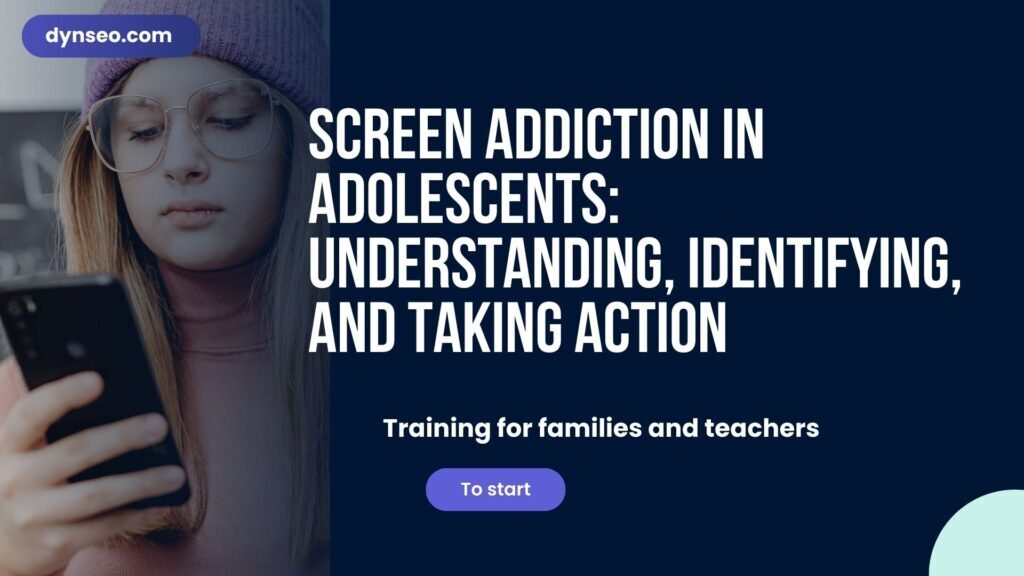
Spotting the signs of screen addiction : practical guide for parents and teachers
Dans cet article
La formation associée
📋 Table of contents
- Why spotting early changes everything
- Clinical criteria for problematic use
- Signals to observe at home
- Signals to observe in class
- Sleep: the first indicator to monitor
- Mood changes related to screens
- Gradual isolation: when virtual replaces real
- Profiles of more vulnerable adolescents
- Girls and boys: different addictions
- What should not be confused with addiction
Spotting screen addiction in an adolescent is not about counting hours. An adolescent can spend 6 hours on their phone without showing problematic use, while another may spend 2 hours in a state of real dependence. Time is one indicator among others — and often not the most relevant. What matters is the impact on life and the adolescent's ability to exercise control over their usage.
This guide provides parents and teachers with concrete benchmarks — not to diagnose (that is not their role), but to observe, question, and decide if a conversation or consultation is necessary.
1. Why spotting early changes everything
Screen addiction, like any addiction, is easier to treat early than at an advanced stage. At the beginning of problematic use, the adolescent still retains the ability to reflect on their usage, non-intrusive living spaces, and receptiveness to adult intervention. The longer problematic use lasts, the more it structures habits, relationships, identity — and the longer and more difficult the way out becomes.
The adults surrounding the adolescent — parents and teachers — are the best positioned to detect early signals. Not because they are trained, but because they see the adolescent every day, in various contexts, and can perceive the gradual changes that the adolescent themselves often does not see.
2. Clinical criteria for problematic use
Health professionals rely on standardized criteria to assess problematic use. Knowing these helps structure observation — without turning parents and teachers into diagnosticians.
✦ The 6 criteria for problematic screen use
- Overwhelming concern — the adolescent constantly thinks about the screen when they are not on it, plans their next session, talks about their usage in an omnipresent way
- Increasing tolerance — usage time gradually increases to achieve the same satisfaction; what was sufficient 6 months ago is no longer sufficient today
- Withdrawal and abstinence — irritability, anxiety, aggression, marked sadness when access to the screen is cut off or delayed
- Loss of control — the adolescent tries to reduce their usage and fails, or systematically exceeds the limits they have set for themselves
- Continuation despite consequences — usage continues despite known negative consequences (drop in grades, family conflicts, loss of sleep)
- Withdrawal from real life — decrease in activities that do not involve screens, reduction in face-to-face social relationships, loss of interest in previous hobbies
The presence of 4 or more criteria over a period of at least 12 months is generally considered characteristic of problematic use requiring professional attention.
3. Signals to observe at home
🔴 Serious signals
Lies about usage (hides the phone, deletes history). Violent outbursts during confiscation. Systematic nighttime usage detected. Total abandonment of previously loved activities. Refusal to eat with family without a screen.
🔴 To monitor closely
Radically different mood depending on access to the screen. Isolation in the room for hours. Neglect of personal hygiene. Abandonment of outings with friends in favor of screens.
🟠 Intermediate signals
Repeated conflicts over screen time. Difficulty falling asleep without the phone. Increasing irritability at the end of the day. One-word responses during meals, gaze drawn to the phone.
🟡 To observe without alarm
Increased screen time during holidays. Strong preference for online activities. Sharp knowledge of certain platforms or games. These elements alone do not mean much.
4. Signals to observe in class
« It's not that he doesn't listen — it's that he can't listen. After two minutes of class, his eyes drift. He seeks a stimulation that I cannot offer as quickly as his phone. »
The observable signs in class are not always spectacular — an addicted student does not necessarily take out their phone ostentatiously. The signals are often more subtle : an inability to maintain attention for more than 5 to 10 minutes, restlessness during activities without screens, marked drowsiness at the beginning of the day or after lunch, irritability at any request for cognitive effort, and sometimes a gradual academic decline without an obvious academic cause.
A student who was sleeping in class and whose average dropped by 4 points in one semester without any known family situation change — this is a profile that deserves a conversation, not a sanction.
Observe and note changes over time. Discuss in the teaching team to cross observations. Report to school administration or the CPE. Offer the student a moment to speak — without accusation, with curiosity. Do not confuse lack of will with neurological inability to maintain attention.
5. Sleep: the first indicator to monitor
Sleep is the first area affected by problematic screen use — and one of the easiest to observe. An adolescent who uses their phone after 10 PM sees their melatonin secretion delayed by 1 to 2 hours. They fall asleep later, get up at the same time for school, and accumulate a chronic sleep debt that affects everything else.
Concrete signs of sleep disorders related to screens : pronounced and permanent dark circles, difficulty getting up in the morning despite a reasonable bedtime, drowsiness in class particularly in the morning, involuntary sleep during the day, systematically bad mood upon waking that improves in the late afternoon. An adolescent showing these signs without any known illness likely has a sleep problem — and a phone left on at night is often the cause.
6. Mood changes related to screens
One of the most telling signals of screen addiction is the close correlation between screen access and emotional state. An adolescent whose mood is radically different depending on whether they have access to their phone — calm and in a good mood with it, irritable and agitated without it — shows a real behavioral dependence.
The question to ask : If you cut off access to screens for 2 hours, what happens? An adolescent with normal usage may be disappointed, bored, but remains functional and finds something else to do. An adolescent with problematic usage shows disproportionate distress — intense irritability, aggression, sometimes tears or rumination. This reaction of withdrawal is an important clinical signal.
7. Gradual isolation: when virtual replaces real
A particularly concerning signal is the gradual withdrawal from real social life in favor of online life. The adolescent stops seeing friends outside of school, refuses family outings, abandons extracurricular activities, spends entire weekends in their room — but is active online, playing with strangers or chatting on social networks.
This withdrawal deserves attention for two reasons. First, it amplifies addiction — online life becomes the only space for socialization, making withdrawal even more difficult. Second, it may mask or exacerbate a pre-existing psychological difficulty — social anxiety, depression, bullying — for which the screen is both a consequence and an anesthetic.
8. Profiles of more vulnerable adolescents
All adolescents are exposed — but some profiles are more vulnerable to problematic use. Knowing these profiles helps guide adult vigilance, without falling into stigmatization.
✦ Vulnerability factors for screen addiction
- Social anxiety — anxious adolescents in face-to-face situations find comfort and less exposure to judgment in online interaction; the risk is that this comfort zone becomes the only social space
- Academic difficulties — the screen offers a space of competence and mastery that school does not provide; a student failing academically may find in video games the only successful experience of their day
- Undiagnosed ADHD — the search for intense stimulation is characteristic of ADHD; high-stimulation screens are particularly magnetic for these adolescents
- Difficult life event — divorce, bereavement, bullying, change of school — screens may become a refuge against untreated psychological pain
- Low self-esteem — validation through likes and followers is a substitute for self-esteem that creates dependence on external validation
9. Girls and boys: different addictions
Screen addictions do not look the same depending on gender — and this difference has important implications for how to spot them.
Among boys, problematic use often manifests around online video games — nighttime sessions, intense emotional investment in the game, conflicts with parents over playtime, gradual withdrawal from school and sports activities. The signs are often more visible and trigger family conflict more quickly.
Among girls, problematic use often revolves around social networks — intensive social comparison, anxiety related to likes and followers, monitoring others' profiles, prolonged nighttime usage. The signs are often more internalized — decreased self-esteem, anxiety, body image disorders — and less visible from the outside. This sometimes makes them detected later.
10. What should not be confused with addiction
Not all intensive screen use is addiction. Adolescents passionate about video creation, programming, or online gaming with a stable group of friends — can spend a lot of time on screens without showing any signs of problematic use. Passion is not addiction.
Similarly, a temporary increase in screen time during a stressful period (exams, friendship breakup, holidays) should not be over-interpreted. It is the persistent, overwhelming, and resistant to control nature that characterizes problematic use — not a one-time spike in a particular context.
🎓 Train your team in early detection
The DYNSEO training “Screen addiction among middle and high school students” trains educational teams to spot signs of problematic use and direct them to the right contacts. Qualiopi certified.
Did this content help you? Support DYNSEO 💙
We are a small team of 14 people based in Paris. For 13 years, we have been creating free content to help families, speech therapists, care homes and healthcare professionals.
Your feedback is the only way we know if our work is useful. A Google review helps us reach other families, caregivers and therapists who need it.
One action, 30 seconds: leave us a Google review ⭐⭐⭐⭐⭐. It costs nothing, and it changes everything for us.