Training teams and involving families : building a true culture of fall prevention
Dans cet article
La formation associée
📋 Summary
- The prevention culture: what really makes the difference
- Why training changes practices — and not just knowledge
- Who to train? The whole team, without exception
- How to train effectively: the formats that work
- The role of management in the prevention culture
- Transmissions: the often forgotten link
- Families: partners, not spectators
- Informing and training families: how and when
- Measuring and managing prevention: useful indicators
- Summary of the series: the 10 prevention levers
Nine articles, nine levers for action. Understanding falls, assessing risk, adapting the environment, prescribing exercises, reviewing medications, adjusting technical aids, preventing nighttime falls, managing residents with dementia, providing care after a fall — all of this is possible, proven, effective. And yet, in many nursing homes, falls continue to occur at the same rate despite the available knowledge. Why?
Because knowledge alone is not enough. What makes the difference between a nursing home where fall prevention is a daily reality and one where it remains a document in a binder is a culture — a collective way of thinking, observing, transmitting, and acting around the safety of residents. And this culture cannot be decreed. It is built through training, by example, through team rituals, and through collaboration with families.
1. The prevention culture: what really makes the difference
A fall prevention culture is a set of values and practices shared by the entire team — from the director to the service agent — that ensures the question “ is it safe for this resident? ” is present in every gesture, every decision, every transmission. It is not a list of procedures. It is a way of being together in service of the residents.
Establishments that achieve the best results in fall prevention share several characteristics : frontline caregivers feel legitimate in reporting a risk, even minor; managers value this reporting rather than minimizing it; a resident's fall is always analyzed collectively; prevention is seen as skilled work, not just common sense; and families are integrated as active partners, not informed afterward.
2. Why training changes practices — and not just knowledge
A study published in the Journal of the American Geriatrics Society showed that caregivers trained in fall prevention report 40% more environmental risk factors than their untrained colleagues — even in the same environment. Training does not change the environment. It changes what we see within it.
This is the first effect of training : making visible what was invisible. A trained caregiver entering a room sees the absent nightlight, the poorly secured rug, the oversized slippers — where the same untrained caregiver saw only an ordinary room. This change in perspective is the condition for any preventive action.
But training has a second effect, less often mentioned : it legitimizes action. A nursing assistant who knows that rugs are a documented risk factor for falls will feel empowered to report it and suggest removing it — where, without this training, they might hesitate to “ interfere in what doesn't concern them ”. Training empowers action.
3. Who to train? The whole team, without exception
Fall prevention is not just the responsibility of the physiotherapist or the coordinating nurse. It is the responsibility of everyone who interacts with residents — which includes often overlooked profiles in training plans.
The coordinating doctor
Leads the medication review, supervises risk assessments, validates individualized prevention plans. Their institutional commitment sets the tone — a medical direction that takes fall prevention seriously impacts the entire establishment's culture.
The nurse
Coordinates risk assessment (Morse, TUG), monitors treatment changes, communicates observations to nursing assistants, alerts the doctor, communicates with the family, documents falls and measures taken. A key player in the entire prevention approach.
The nursing assistant
First observer of the resident's condition on a daily basis — changes in gait, abandonment of technical assistance, reported dizziness, wet floors. Their ability to observe and communicate is the most effective early warning system in the establishment.
The physiotherapist and the occupational therapist
Assess functional abilities (TUG, Tinetti), prescribe and adjust exercise programs, choose and set up technical aids, conduct environmental audits. Their role in active prevention is central and often underutilized.
The service agents and hotel staff
Immediately report wet floors, ensure that hallways are clear after meal service, rearrange furniture after cleaning. Simple actions, but an essential link in the prevention chain.
4. How to train effectively: formats that work
Classroom training, lectures, theoretical — the mandatory annual training day — has limited value in fall prevention. Knowledge quickly fades if not anchored in practice. The most effective formats are those that combine short theoretical inputs with concrete situational practice and are repeated regularly.
✦ Effective training formats for fall prevention
- Certified training — like DYNSEO Qualiopi training, it provides a comprehensive framework, validated tools, and institutional legitimacy to the prevention approach. OPCO funding possible.
- Practical workshops — learning to use the Morse scale on real cases, performing the TUG test in the room, practicing lifting a fallen person. What we did in training, we remember.
- Short team briefings — 5 to 10 minutes during handovers to share an observation, remind a gesture, comment on a recent fall. Frequent repetition is better than rare intensive training.
- Analysis of real cases — collectively debriefing a fall that occurred in the facility is powerful training, grounded in the reality experienced by the team.
- Mentoring — training an expert caregiver (fall prevention referent) who shares their knowledge in situ, at the patient's bedside, in the hallways. More effective than traditional training for gestures and reflexes.
5. The role of management in the prevention culture
The nursing supervisor, the director of care, management — their behavior shapes the culture of the facility more than any institutional policy document. If management mobilizes after every serious fall and demands an analysis, the team understands that prevention is taken seriously. If they minimize, classify without follow-up, or never provide feedback on reports, the message is the opposite.
« What has changed in our Nursing home is not the protocol — it has existed for years. It's that the supervisor started asking at every team meeting: "Have we had any falls? What have we learned from them?" Two simple questions. It changed everything. »
6. Transmissions: the often forgotten link
The transmission between teams — between day and night, between weekend and week — is the link where information about risks is most often lost. A caregiver who observed that a resident “has been walking strangely since yesterday morning” and did not report it missed an opportunity for prevention. A night nurse who does not know that a resident has a new medication that can cause dizziness cannot monitor accordingly.
What should always be included in reports related to fall prevention : any change in gait or balance observed within 24 hours, abandonment or refusal of usual technical assistance, dizziness or discomfort reported by the resident, introduction or modification of a potentially risky medication, fall occurred (even without injury), change in general condition (infection, fever, confusion) — a frequent triggering factor for falls. This information has real clinical value. It deserves to be communicated with as much care as a change in blood pressure or a lab result.
7. Families: partners, not spectators
Families are present in the lives of residents in a way that caregivers cannot replicate — they know the person's history, fears, habits, and abilities before the Nursing home. And they are there during visits, often several times a week, with a fresh perspective on developments that the team no longer perceives due to continuity.
Too often, families are treated as recipients of information (they are told what happened) rather than as actors in prevention (they are explained what they can observe and do). This change in posture — from information to participation — is one of the most underutilized levers for fall prevention.
Observe
Families see the gradual changes that the accustomed team may miss — evolved gait, abandonment of an activity, new complaints. Their observation has real clinical value.
Report
Transmit their observations to the nurse during each visit, not just when a fall has occurred. A simple and valued reporting channel multiplies early warning sources.
Encourage
Value the use of a cane or walker, encourage walking during visits, support motivation for exercises. The caring gaze of the family is a powerful compliance lever.
Adapt (at home)
For residents on temporary outings or relatives living at home — secure the environment, adapt footwear, install a night light, remove rugs. Concrete actions within their reach.
8. Informing and training families: how and when
Families do not always know what they can do — because no one has told them. Organizing information sessions specifically dedicated to fall prevention — during family meetings, during admission interviews, via educational sheets handed out during visits — is a high-return investment.
The 5 actions families can take during each visit : check footwear (Velcro shoes and non-slip soles), see if the technical assistance is within reach and in good condition, observe gait during movements, listen if the relative complains of dizziness or difficulty getting up, and report to the nurse any changes since the last visit.
« You are our best observers. What you see during visits is precious to us. Never hesitate to report a change, even if you are not sure it is important — we will sort it out. »
9. Measuring and managing prevention: useful indicators
What cannot be measured cannot be improved. Fall prevention must be managed with indicators that are regularly monitored and shared with the team. Not to blame, but to see progress, identify problems, and adjust actions.
✦ Fall prevention indicators to monitor in Nursing home
- Fall rate — number of falls / number of residents / month. To be monitored over time, to compare before/after an intervention.
- Fall rate with injury — more refined than the gross rate, it measures severity.
- Percentage of residents with up-to-date risk assessment — measures the completeness of the assessment process.
- Average time for post-fall analysis — how many days between the fall and the documented team analysis.
- Rate of residents with documented individualized prevention plan — for residents at moderate and high risk.
- Training coverage rate of the team — percentage of caregivers who have received training in fall prevention within the last 2 years.
💡 Share the indicators with the team. A dashboard displayed in the care room, updated each month, transforms the indicators into team tools rather than control tools. When the team sees that the fall rate has decreased after the installation of automatic night lights, they concretely understand that their actions have an impact. This reinforces motivation and the culture of prevention much more effectively than a sensitization meeting.
10. Summary of the series: the 10 levers of prevention
This series of 10 articles has explored all the levers for fall prevention available to caregivers and families. Here they are gathered again — because no single lever is sufficient, and it is their combination that produces sustainable results.
🦺 The 10 levers of fall prevention
Understand the causes and consequences of falls
Assess the risk with validated tools (Morse, TUG, Tinetti)
Adapt the environment: room, bathroom, lighting, flooring
Prescribe balance and strengthening exercises
Review high-risk medications and combat iatrogenesis
Adapt and maintain technical aids (cane, walker…)
Prevent nighttime falls: nocturia, lighting, safe getting up
Adapt prevention for residents with dementia
Manage after the fall and prevent recurrence
Training teams and involving families as partners
These ten levers are not a checklist. They are dimensions of the same approach: to view each resident as a person with their own risk factors, their own resources, their own history, and to build with them, their surroundings, and the team an environment and support that allow them to stay upright — and free.
Falling is not a fatality. It is a risk, like others, that can be managed. And every fall avoided is, behind the statistics, a person who has been able to continue walking to the dining room, go to the bathroom alone at night, go out into the garden on Wednesday afternoons. Small freedoms. Great dignities.
🎓 The complete training for your entire team
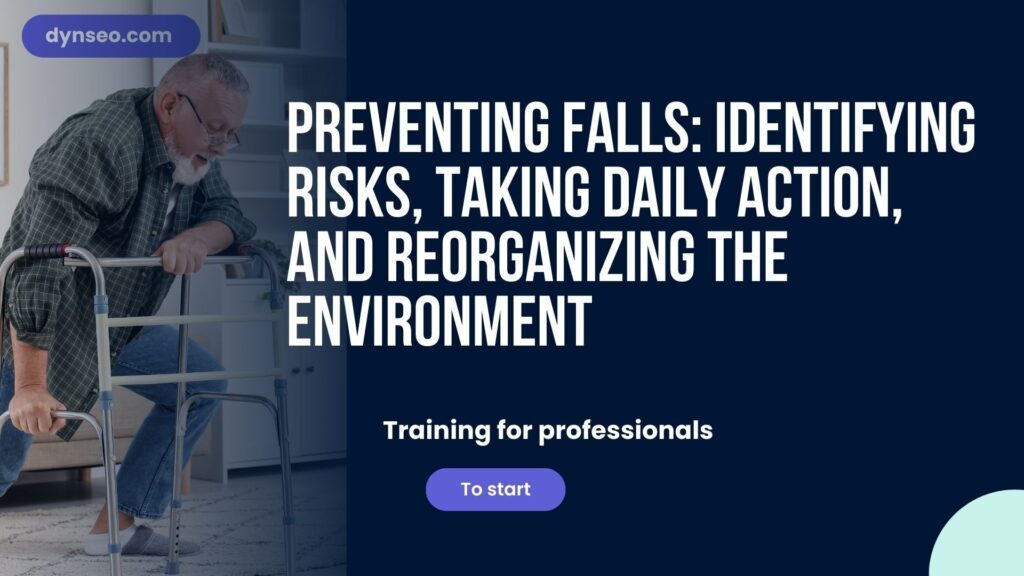
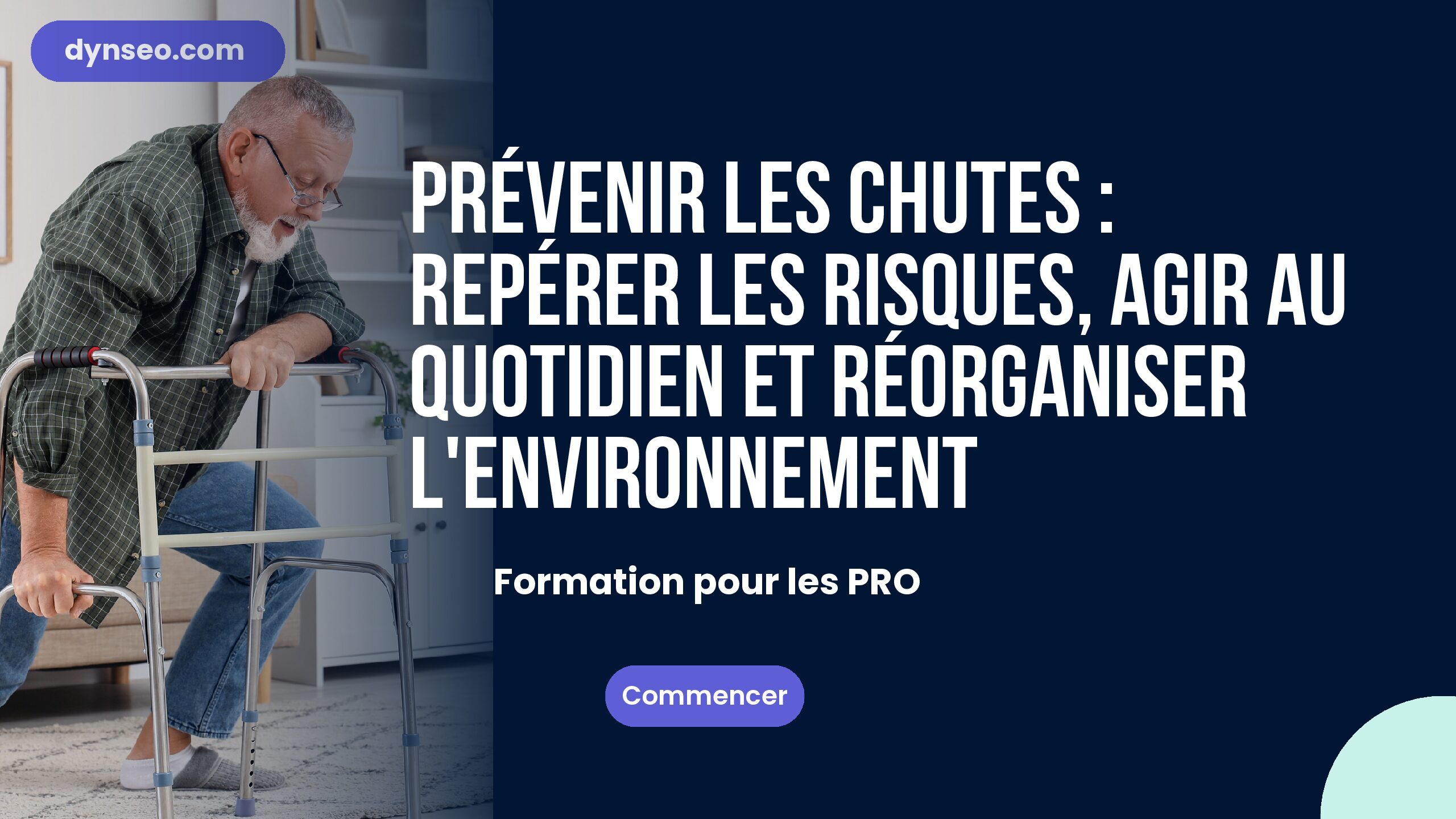
The DYNSEO training “Preventing falls — identifying risks, acting daily, and reorganizing the environment” covers all the levers of this series. Certified Qualiopi, fundable by OPCO, suitable for all members of the caregiving team.
Did this content help you? Support DYNSEO 💙
We are a small team of 14 people based in Paris. For 13 years, we have been creating free content to help families, speech therapists, care homes and healthcare professionals.
Your feedback is the only way we know if our work is useful. A Google review helps us reach other families, caregivers and therapists who need it.
One action, 30 seconds: leave us a Google review ⭐⭐⭐⭐⭐. It costs nothing, and it changes everything for us.