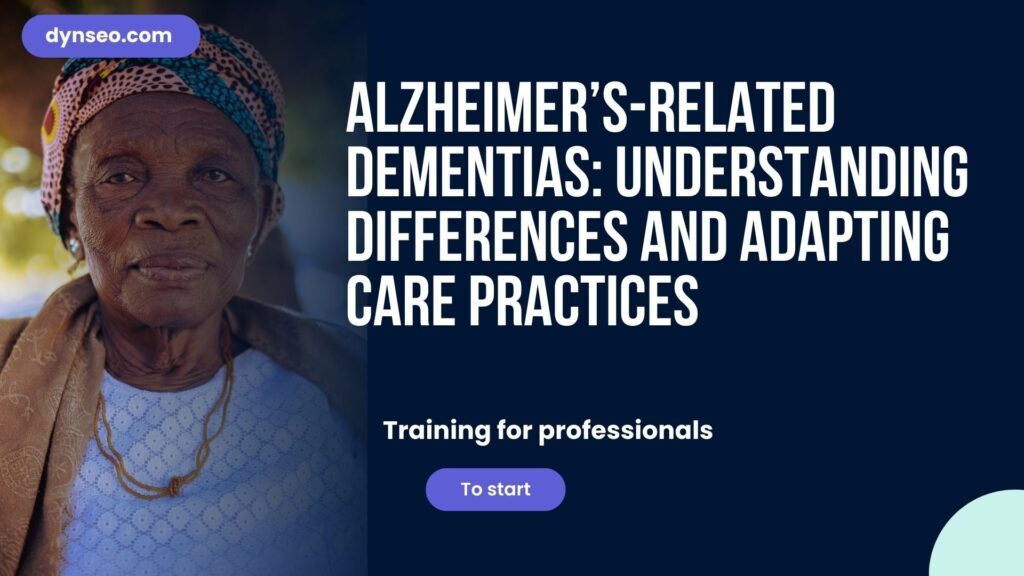
Diseases related to Alzheimer's disease: understanding, distinguishing, and adapting practices in medicalized residences
Program, content, and benefits of DYNSEO training — for professionals in nursing homes, USLD, and medicalized residences facing dementia syndromes beyond Alzheimer's.
Access the training →Dans cet article
La formation associée
Les ressources citées
 Thermomètre des émotions
 Décodeur d'Expressions Faciales
 Roue des choix - Outils Formation DYNSEO
In nursing homes, "dementia" is often discussed as a uniform block — and practices are adapted as if all dementia syndromes function in the same way. This is a serious mistake. Lewy body dementia, frontotemporal dementia, vascular dementia, Creutzfeldt-Jakob disease — these diseases "related" to Alzheimer's share cognitive degeneration with it, but differ profoundly in their mechanisms, manifestations, treatments, and support needs. A resident with DLB who presents visual hallucinations is not managed the same way as an agitated Alzheimer's resident. A resident with FTD whose social disinhibition shocks the team is not "bad-willed" — it is their frontal lobe that is affected. DYNSEO training gives you the keys to see these differences, adapt your practices, and concretely improve the quality of life of your residents.
1. The landscape of dementia syndromes in medicalized residences
1.1 Alzheimer's is not alone
Alzheimer's disease accounts for about 60 to 70% of dementia cases — which means that 30 to 40% of residents with cognitive disorders suffer from another pathology. In medicalized residences, this percentage is even higher due to the complexity of the profiles hosted. Yet, the training of professionals focuses almost exclusively on Alzheimer's — leaving teams helpless in the face of atypical presentations, "incomprehensible" behaviors, and situations where Alzheimer's protocols do not work.
1.2 Why distinguishing syndromes changes everything
The distinction between dementia syndromes is not an academic exercise reserved for neurologists. It has direct practical consequences on the safety of residents (antipsychotics are contraindicated in Lewy body dementia but used in certain situations of Alzheimer's), on the effectiveness of support (distraction approaches that work in Alzheimer's can worsen agitation in FTD), and on the relationship with families (understanding that the disinhibition of a DFT resident is neurological and not educational profoundly transforms exchanges with relatives).
2. Related diseases: clinical overview for professionals
🧠 Alzheimer's disease
- Episodic memory affected first
- Slow and steady progression
- Early spatial-temporal disorientation
- Apraxia, agnosia, aphasia over time
- No typical hallucinations at the beginning
👁️ Lewy Body Dementia (LBD)
- Early and recurrent visual hallucinations
- Significant cognitive fluctuations day to day
- Parkinsonian syndrome often associated
- Behavioral disorders in REM sleep
- Hypersensitivity to neuroleptics — DANGER
🧩 Frontotemporal Dementia (FTD)
- Social disinhibition, inappropriate behaviors
- Memory often preserved for a long time
- Apathy or hyperorality (eats everything)
- Semantic variant: loss of meaning of words
- Motor variant: parkinsonian signs or ALS
🩸 Vascular Dementia
- Often abrupt onset post-Stroke
- Progression in "stair-step" fashion
- Executive functions primarily affected
- Variability of deficits depending on affected areas
- Cardiovascular prevention is key
🔄 Mixed and Rare Dementias
- Combination of several pathologies
- PSP: frequent falls, altered vertical gaze
- MSA: severe dysautonomia
- Creutzfeldt-Jakob disease: very rapid progression
- Often late or post-mortem diagnosis
3. DYNSEO training: distinguishing to better support
Alzheimer's-related diseases: understanding, distinguishing, and adapting practices in medicalized residences
This online certified training is aimed at professionals working in Nursing homes, USLD, medical residences, and at home. It provides fundamental clinical knowledge to distinguish Alzheimer's from related syndromes, and concrete support strategies adapted to each pathology.
Access the training →3.1 What you will learn — module by module
The training is structured around four major progressive axes: understanding the mechanisms of each pathology, learning to clinically distinguish them, adapting care practices, and managing complex behavioral situations specific to each syndrome.
📋 Detailed training content
- Module 1 — Neurology of dementias: Compared neuropathological mechanisms, brain imaging (MRI, SPECT, PET), biomarkers and differential diagnosis
- Module 2 — Alzheimer's vs MCI: Compared cognitive profiles, visual hallucinations: assessment and appropriate response, danger of neuroleptics in MCI
- Module 3 — Frontotemporal dementia: Understanding disinhibition, managing hyperorality, communicating with families about shocking but neurological behaviors
- Module 4 — Vascular dementia: Prevention of vascular risk factors, adaptation to focal deficits, management of Stroke sequelae
- Module 5 — Adapting practices in residence: Environment, communication, activities, care — differentiated approaches by syndrome
- Module 6 — Managing behavioral crises: Identifying the cause, responding without medication, when to alert the doctor
- Module 7 — Caring for teams: Emotional impact of dementia syndromes on caregivers, prevention of professional burnout
4. Comparative table: adapting practices according to the syndrome
5. Adapting the environment and activities in a medicalized residence
5.1 The environment as therapy
The physical environment of a care unit is a therapy in itself in dementias. For residents with MCI whose hallucinations are aggravated by reflections and strong contrasts, reducing mirrors and shiny surfaces can drastically decrease the frequency and intensity of hallucinatory episodes. For FTD residents whose disinhibition is exacerbated by excessive sensory stimulation, a calmer and more predictable environment reduces disruptive behaviors. For Alzheimer's residents whose disorientation generates anxiety, colorful visual markers (pictograms on bedroom doors, distinctive colors by area) are effective guides.
Light and space for MCI
Stable lighting without strong shadows. Avoid mirrors in rooms. Reduce visual contrasts that generate illusions and fuel hallucinations.
Predictable environment for ADHD
Reduced and predictable sensory stimulation. Strict routines. Avoid complex social situations that trigger disinhibition.
Structured music for Alzheimer's disease
Familiar and rhythmic music during care. Personalized playlists. Musical memory lasts long in Alzheimer's — a powerful lever.
Visual markers for vascular dementia
Pictograms on each door. Large room numbering. Unit plans displayed. Compensate for focal deficits with external supports.
Communication adapted to each syndrome
Use informal or formal address depending on the personality. Adjust pace, intensity. Use MON DICO pictograms for residents with aphasia or fluctuating cognitive disorders.
Visible and structuring planning
Daily program displayed in images. Announce each transition. Predictability reduces anxiety in all dementia syndromes.
5.2 DYNSEO tools in medicalized residences
The DYNSEO Emotion Thermometer is particularly useful in dementia syndromes where the person may have difficulty verbally expressing their suffering — it allows the caregiver to assess the emotional state non-verbally and to record variations. The DYNSEO Facial Expression Decoder helps interpret residual facial expressions in syndromes where emotional richness persists long despite cognitive disorganization. The Session Tracking Sheet structures observations during each interaction and allows the team to monitor behavioral evolution.
6. Managing complex behaviors without over-medicalization
6.1 Identify before acting
Most disruptive behaviors in dementia have a cause — which can be neurological (the syndrome itself), environmental (too much noise, poor lighting), somatic (unexpressed pain, infection, constipation) or relational (unknown caregiver, modified routine). DYNSEO training emphasizes the fundamental principle: every behavior is communication. Before intervening — and especially before medicalizing — it is essential to identify the cause.
🔍 The 4 causes to always explore before medicalization
- Somatic cause: Pain (use the ALGOPLUS scale), urinary infection, constipation, retention, adverse drug effect
- Environmental cause: Sensory overload, change of room or caregiver, meal time shifted, inappropriate temperature
- Relational cause: Unknown caregiver, abrupt approach, communication inappropriate to the syndrome, context of fear or humiliation
- Neurological cause: Fluctuation specific to the syndrome (fluctuating cognitive disorders), post-anesthesia confusion period, psychotic episode related to the pathology
⚠️ Alert DCL : In Lewy body dementia, neuroleptics (haloperidol, risperidone, olanzapine) can cause a severe sensitivity reaction that may endanger life. This information must be known by the entire care team. In case of doubt about the diagnosis, contact the coordinating physician before any prescription of neuroleptic.
7. Taking care of the care teams
7.1 Burnout in dementia units
Working daily with residents presenting complex dementias — hallucinations, agitation behaviors, disinhibition, aggression — generates considerable emotional and cognitive burden. The burnout rate in care teams in Nursing homes is one of the highest in the medico-social sector. The DYNSEO training dedicates an entire module to the prevention of this burnout: identifying early signals, developing individual and collective emotional regulation strategies, and creating debriefing spaces within the team.
🎓 Train your team now
The DYNSEO training on Alzheimer's-related diseases is available online, at your own pace, certified Qualiopi — OPCO funding possible for professionals. Transform your team's understanding and concretely improve the quality of life of your residents.
8. DYNSEO tools and applications for medicalized residences
🌡️ Emotion thermometer
Assess emotional state without words — essential for syndromes with altered communication.
Download →🎭 Facial expression decoder
Interpret residual emotions — particularly useful in facial mask dementias.
Download →🎡 Choice wheel
Communication by pointing — suitable for residents with aphasia or motor speech disorders.
Download →📊 Skills tracking chart
Document cognitive and behavioral evolution — communication support for the team.
Download →📋 Session tracking sheet
Record each interaction — ensures continuity of care among team members.
Download →🟨 SCARLETT — Seniors
cognitive stimulation adapted to dementia profiles — large buttons, simple gestures, activities tailored to the level of the disease.
Discover SCARLETT →🟥 MY DICTIONARY — AAC
Alternative communication through pictograms — for residents with aphasia or severely impaired verbal communication.
Discover MY DICTIONARY →🟦 CLINT — Adults
For caregivers themselves — adult cognitive stimulation to maintain one's own mental health in a demanding profession.
Discover CLINT →🤖 DYNSEO AI Coach
Questions about dementia syndromes, complex behaviors, support adaptations — expert answers 24/7.
Discover the AI Coach →❓ Frequently Asked Questions about the training
Who is this training specifically aimed at?
The training is primarily aimed at professionals working in nursing homes — nursing assistants, nurses, housekeeping staff, activity coordinators, psychologists, occupational therapists, health managers, coordinating doctors. It is also accessible and relevant for home care professionals (SSIAD, home helpers) and for families wishing to deepen their understanding of their loved one's condition. No formal medical prerequisites are required — the training is designed to be educational and accessible.
What is the concrete difference between Lewy body dementia and Alzheimer's in daily life?
In nursing homes, the most striking difference is the presence of detailed and recurrent visual hallucinations in LBD (the resident "sees" people, animals, objects that do not exist) and cognitive variability from day to day (the resident may seem "almost normal" in the morning and very confused in the afternoon). In Alzheimer's, the progression is more linear and hallucinations, when they appear, are generally late. This distinction has a major medical implication: neuroleptics, sometimes used for agitation in Alzheimer's, can be potentially fatal in LBD.
How does the training help manage disruptive behaviors in FTD?
Frontotemporal dementia generates behaviors that shock teams (sexual disinhibition, food theft, hurtful remarks, repetitive behaviors) and are often misinterpreted as "bad will" or a "lack of education." The training explains the neurology of these behaviors (prefrontal cortex lesion = loss of the inhibitory filter) and offers concrete strategies: diverting attention to an alternative activity, structuring the environment to limit triggers, and above all — training families who are often the first to be shocked by these behaviors.
Can the training be used to obtain continuing education hours?
Yes. DYNSEO's Qualiopi certification allows for the recognition of the training within the framework of continuing professional education. For nurses and nursing assistants, the hours can be declared as part of their DPC (Continuous Professional Development) or their annual training plan. For coordinating doctors, the hours are eligible for continuing medical education. Contact DYNSEO to obtain the certificates and documents necessary for the declaration.
Can we use SCARLETT with residents suffering from LBD or FTD?
Yes, with some adaptations depending on the profile. For LBD residents whose abilities fluctuate greatly, SCARLETT is ideally used during periods of good cognition (morning or after medication intake). Calm visual activities are preferable to activities with strong contrasts. For FTD residents whose behaviors can be unpredictable, short sessions (10-15 minutes) with a companion are preferable to independent sessions. DYNSEO training provides practical guidance for using the tools according to each syndrome.
How to explain frontotemporal dementia to a resident's family?
This is one of the most delicate situations in nursing homes. The family of an FTD resident often suffers in the face of behaviors they interpret as a moral degradation of their loved one ("he would never have said that before"). The training offers a simple and effective metaphor: "Your loved one's brain has lost its director — the prefrontal cortex that filtered behaviors. What you see now is the rest of the brain expressing itself without a filter. It is not your loved one speaking — it is their illness." This explanation generally transforms the family's reaction from shame and anger to understanding and empathy.
Is there a module on end-of-life care in dementia syndromes?
Yes. The training includes a module on end-of-life support in various dementia syndromes — each presenting specific characteristics. LBD may progress more rapidly than Alzheimer's once advanced stages are reached. FTD requires particular attention to communication with families about the progression of the disease. Vascular dementia may alternate between phases of stability and sudden exacerbations. The training addresses palliative care specific to dementias, advance directives, and how to discuss them with residents still able to articulate them.
How to justify the investment in this training to my nursing home management?
Several factual arguments: the reduction in the number of serious medication incidents (neuroleptics in LBD), the decrease in disruptive behaviors thanks to better-targeted interventions, the reduction in caregiver turnover due to a better understanding of difficult situations (reduction of burnout), and the improvement of quality evaluations during inspections. Studies show that an 8-hour training on dementia syndromes reduces behavioral adverse events in nursing homes by 30% — a very concrete ROI.
Diseases related to Alzheimer's disease: understanding, distinguishing, and adapting practices
Online, at your own pace, certified Qualiopi — the training that gives your team the keys to distinguish dementia syndromes and adapt its practices to each resident.
Access the training →Did this content help you? Support DYNSEO 💙
We are a small team of 14 people based in Paris. For 13 years, we have been creating free content to help families, speech therapists, care homes and healthcare professionals.
Your feedback is the only way we know if our work is useful. A Google review helps us reach other families, caregivers and therapists who need it.
One action, 30 seconds: leave us a Google review ⭐⭐⭐⭐⭐. It costs nothing, and it changes everything for us.