Managing Transitions and Changes in Daily Life with an Autistic Child
Visual strategies, gradual preparation, and concrete tools to help your child navigate smoothly between activities, places, and the unexpected events of daily life.
Dans cet article
Transitions are one of the main sources of stress for autistic children and their families. Moving from one activity to another, leaving the house, entering a store, accepting a change in plans: these moments, trivial for most children, can trigger intense anxiety, meltdowns, or outright refusal in an autistic child. This is neither opposition nor a whim: it is the manifestation of a real neurological difficulty in facing unpredictability and change. Understanding this difficulty is the first step to responding effectively.
🧠 Why transitions are so difficult
To understand the difficulty of transitions, one must adopt the perspective of the autistic child. Their brain functions in a way that prioritizes predictability, stability, and routines. Each ongoing activity creates a "mental world" in which the child settles: they know the rules, expectations, and sensory stimuli. The transition requires them to leave this known world for another, potentially unpredictable one, and this shift intensely challenges their executive functions, particularly mental flexibility.
Mental flexibility, that is, the ability to change perspective, activity, or strategy in response to a change in situation, is one of the cognitive functions most often impacted in ASD. When this function is fragile, each transition becomes a considerable cognitive effort, comparable to what a neurotypical adult would feel if asked to abruptly change complex work tasks every five minutes.
Mental flexibility
Neurological difficulty in shifting from one mode of operation to another, generating stress and resistance to change
Need for predictability
Uncertainty about what will happen next generates anxiety that can be paralyzing or explosive
Sensory load
Each new place brings new sensory stimuli to manage, amplifying the difficulty of the transition
📋 Visual transition supports
Visual supports are the most effective tools for facilitating transitions. They make visible and concrete what is going to happen, reducing uncertainty and giving the child time to mentally prepare for the change. Several types of supports can be used, alone or in combination.
Visual schedule
The visual schedule is the basic tool. It represents the sequence of activities for the day with images, pictograms, or photos, depending on the child's level of understanding. The child can consult their schedule at any time to know what is going to happen, which reduces anxiety related to uncertainty. When an activity is finished, the child removes it from the schedule (or turns it over, the bar), making the progression visible and concrete.
Visual timer
The visual timer concretely shows the time remaining before the end of an activity or before a transition. Analog timers with a colored area that gradually decreases are particularly effective because they provide a concrete representation of passing time, an abstract concept often difficult for children with autism. The timer alerts the child that the transition is approaching without making it abrupt.
Social stories
For transitions to new or unusual situations, social stories (short illustrated narratives describing what is going to happen) are a valuable tool. They present the place, people, steps, and expected behaviors in a concrete and reassuring manner. The child reads or listens to them before the transition and can refer to them during if necessary.
💡 The "first..., then..." rule
The structure "first [current activity/transition], then [motivating activity]" is a simple yet very effective strategy. By associating the transition with a preferred activity that comes afterward, you create a positive motivation to accept the change. For example: "First we put on our shoes, then we go to the park." A visual support with both images side by side makes this structure even clearer.
🔔 Prepare for changes in advance
Preparation is key to successful transitions. The more the child is informed in advance about what is going to happen, the more time they have to mentally adapt, and the less stressful the transition will be. This preparation should be tailored to the child's level of understanding and the significance of the change.
For daily transitions (end of an activity, leaving for school), a warning given five minutes before, then two minutes before, allows the child to finish what they are doing and mentally prepare. For more significant transitions (doctor's visit, unusual outings), preparation starts the day before or in the morning with a social story, photos of the place, and a description of the steps.
For major changes (moving, changing schools, arrival of a baby), preparation is gradual and spans several weeks. It includes prior visits, books or stories on the theme, role-playing, and a gradual introduction of new elements into the child's daily life.
⏱️ The micro-transitions of daily life
A child's daily life is marked by dozens of micro-transitions that go unnoticed for neurotypical children but represent challenges for a child with autism: stopping playing to come eat, getting up from the couch to brush their teeth, leaving the house to get into the car, getting out of the car to enter school.
To smooth these micro-transitions, systematic and predictable strategies are essential. A transition ritual, always the same for a given type of change, creates a bridge between the two activities and reduces uncertainty. For example, a cleanup song systematically signals the end of playtime, a bell sound announces mealtime, and a particular gesture (hand on the shoulder, touching a transition object) accompanies movements.
- Transition objects: an object that the child takes from one activity to another (stuffed animal, small toy, card) that creates reassuring continuity
- Passage rituals: sequences of actions that are always the same marking the beginning and end of each activity
- Warning signals: timer, song, light signal that announce the transition a few minutes in advance
- Destination photos: showing the child a photo of the place they are going to make the destination concrete
🏠 Major life changes
Major life changes — moving, changing schools, divorce, the birth of a sibling, the death of a loved one — are challenges for any child, but they can be particularly destabilizing for a child with autism whose balance relies on the stability of their environment.
Preparing for a major change should start as early as possible and be gradual. For a move, for example, regular visits to the new home, photos of the different rooms integrated into a preparation album, the gradual transfer of familiar objects, and a faithful reconstruction of the organization of the room help create landmarks in the new environment even before settling in.
During and after the change, maintaining as many familiar routines as possible is essential. If the location changes, the daily habits should remain as stable as possible. This continuity of routines offers reassuring anchorage amidst the upheaval.
⚠️ Do not underestimate the impact of "minor" changes
What seems minor to an adult can be experienced as a seismic event by a child with autism: a change in route to school, a new teacher, a modification of the cafeteria menu, the replacement of a piece of furniture in the living room. These "minor" changes also deserve preparation and support, as they disrupt established references and can generate disproportionate stress in the eyes of parents.
🎮 COCO THINKS and COCO MOVES: structured transitions
The COCO THINKS and COCO MOVES program from DYNSEO naturally integrates transitions into its structure. The mandatory alternation every 15 minutes between cognitive activities and physical activities offers regular and predictable training for transition. The child knows that after COCO THINKS comes COCO MOVES, and vice versa: this predictability makes the transition acceptable and even enjoyable.
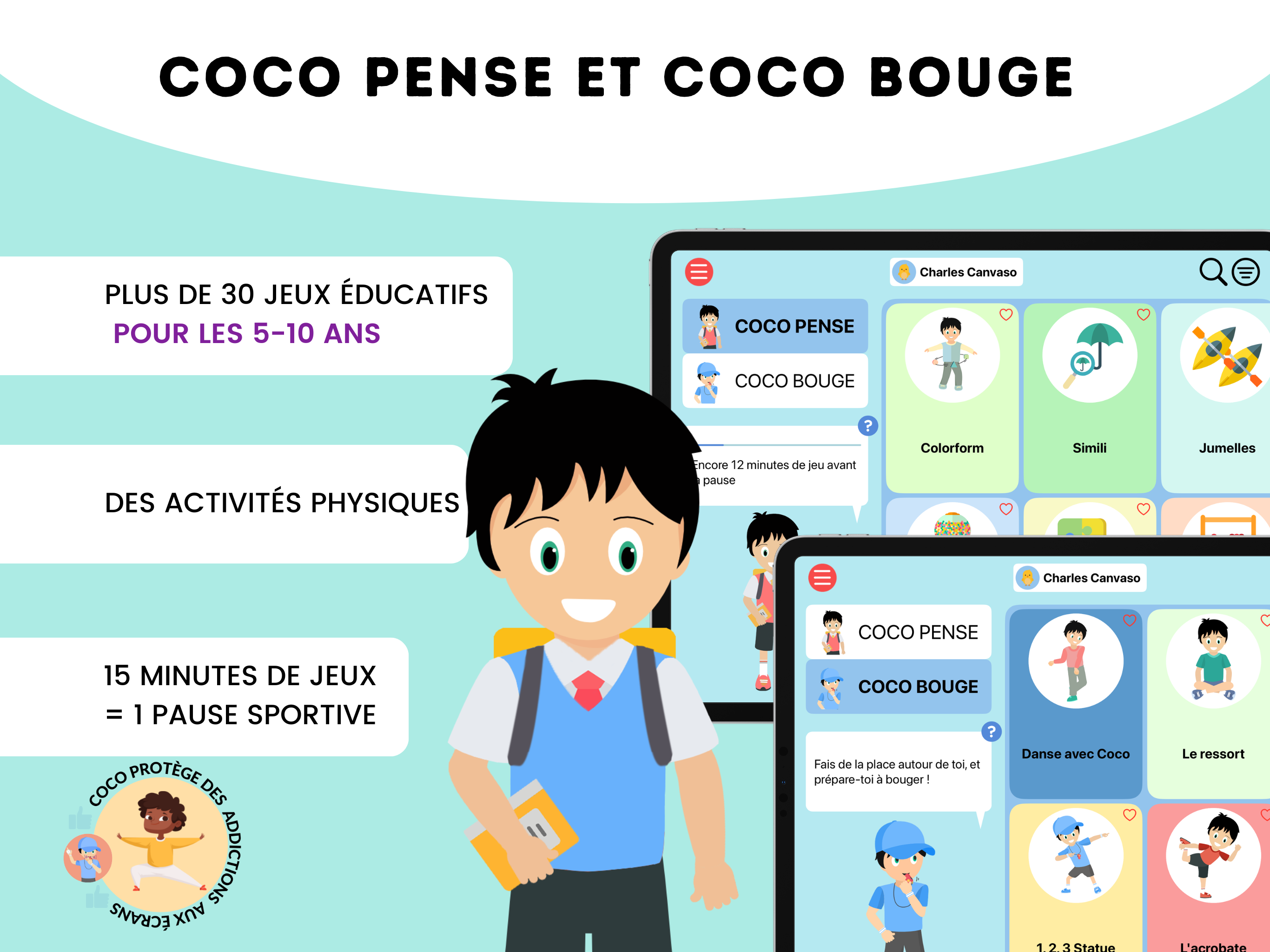
This regular training for transition in a safe and motivating environment can help develop the child's mental flexibility. By experiencing that changing activities leads to something enjoyable, the child gradually integrates that transitions are not threatening, a skill that can generalize to other situations in daily life.
🎯 Discover COCO THINKS and COCO MOVES
A program that trains mental flexibility through structured and predictable transitions between cognitive and physical activities.
Discover the COCO program →🌪️ When the unexpected happens
Despite the best preparation, the unexpected is part of life and it is impossible to anticipate everything. The canceled appointment, the blocked road, the power outage, the planned activity that is closed: these situations confront the child with autism with what they fear most, total unpredictability.
The "joker card" or "surprise card" strategy is a useful tool. A specific pictogram, integrated into the child's communication system, represents the unexpected. The child gradually learns, in controlled situations, that the surprise card means "something different is going to happen" and that they can manage this situation. We start with pleasant surprises (unplanned outing, favorite activity as a bonus) before introducing neutral changes and then less pleasant situations.
When an unexpected event occurs, it is important to acknowledge the child's difficulty ("I know this is not what we had planned, and it's hard"), to give them the available information about what will happen next ("Here’s what we will do instead") and to offer a regulation strategy if necessary (comfort object, break, calming activity).
The DYNSEO guides for supporting children with autism and supporting adults with autism provide complementary strategies for managing transitions and the unexpected in daily life.
🎓 Training with DYNSEO
DYNSEO offers a certified Qualiopi training "Supporting a child with autism: keys and solutions for daily life" that thoroughly addresses strategies for managing transitions and changes.

🎓 Learn to facilitate transitions
Certified Qualiopi training accessible online to master strategies for managing transitions and changes in daily life.
Discover the training →🎯 Conclusion
Transitions and changes are daily challenges for children with autism and their families, but they are not insurmountable. With the right tools — visual supports, timers, social scenarios, transition rituals — and appropriate preparation, most transitions can become smooth and serene. Programs like COCO THINKS and COCO MOVES naturally train mental flexibility through structured and predictable transitions.
The key is predictability: the more the child knows what is going to happen, the less anxiety the transition causes. Over time and with practice, many children gradually develop a better tolerance for change, especially when transitions are associated with positive experiences.
Anticipate, prepare, support:
Serene transitions for the whole family.
Did this content help you? Support DYNSEO 💙
We are a small team of 14 people based in Paris. For 13 years, we have been creating free content to help families, speech therapists, care homes and healthcare professionals.
Your feedback is the only way we know if our work is useful. A Google review helps us reach other families, caregivers and therapists who need it.
One action, 30 seconds: leave us a Google review ⭐⭐⭐⭐⭐. It costs nothing, and it changes everything for us.